We ran an 8.4 m outboard boat at its 33-knot top speed in Notilus CFD, free to rise and trim, and compared the result with the Savitsky planing method and the boat's sea trial. The predicted engine power, 310–375 hp, brackets the 350 hp outboard the boat ran on.
The boat and the question
The boat is an 8.4 m monohull with a V-bottom of about 21° deadrise, 2.6 m beam at the chines and a single 350 hp outboard turning a 15.3 × 14 in propeller. It displaces about 3.8 tonnes. On sea trials it reached 33 knots at full throttle.
At 33 knots the boat is fully planing: its volume Froude number is 4.4. For a planing hull the design questions come as a chain. How far does the boat lift, how much does it trim, how much resistance does it make — and so, what engine does it need?
Hand methods answer that chain in minutes, but with an error you cannot see. We wanted to know what a full simulation inside Rhino would say, for a boat whose answer we already had.
What we simulated
Notilus CFD ran the hull as drawn in Rhino, at full scale, in calm water at 33 knots. The boat was free to rise and to trim, so it found its own running attitude. The run stopped by itself once lift, trim and resistance had stopped changing.
The figures below are averages over the last 1.2 seconds of the run. Trim and rise are measured from the boat's attitude at rest.
The simulation gives the resistance of the hull in the water. On top of it come a standard allowance for hull roughness and the air resistance of the boat's 6.5 m² frontal area. The engine power then follows from a propulsive efficiency of 0.50–0.60, typical for an outboard at this speed.
Results
The boat settled at 3.9° bow-up trim and a 0.32 m rise of its centre of gravity, with 8.2 kN total resistance.
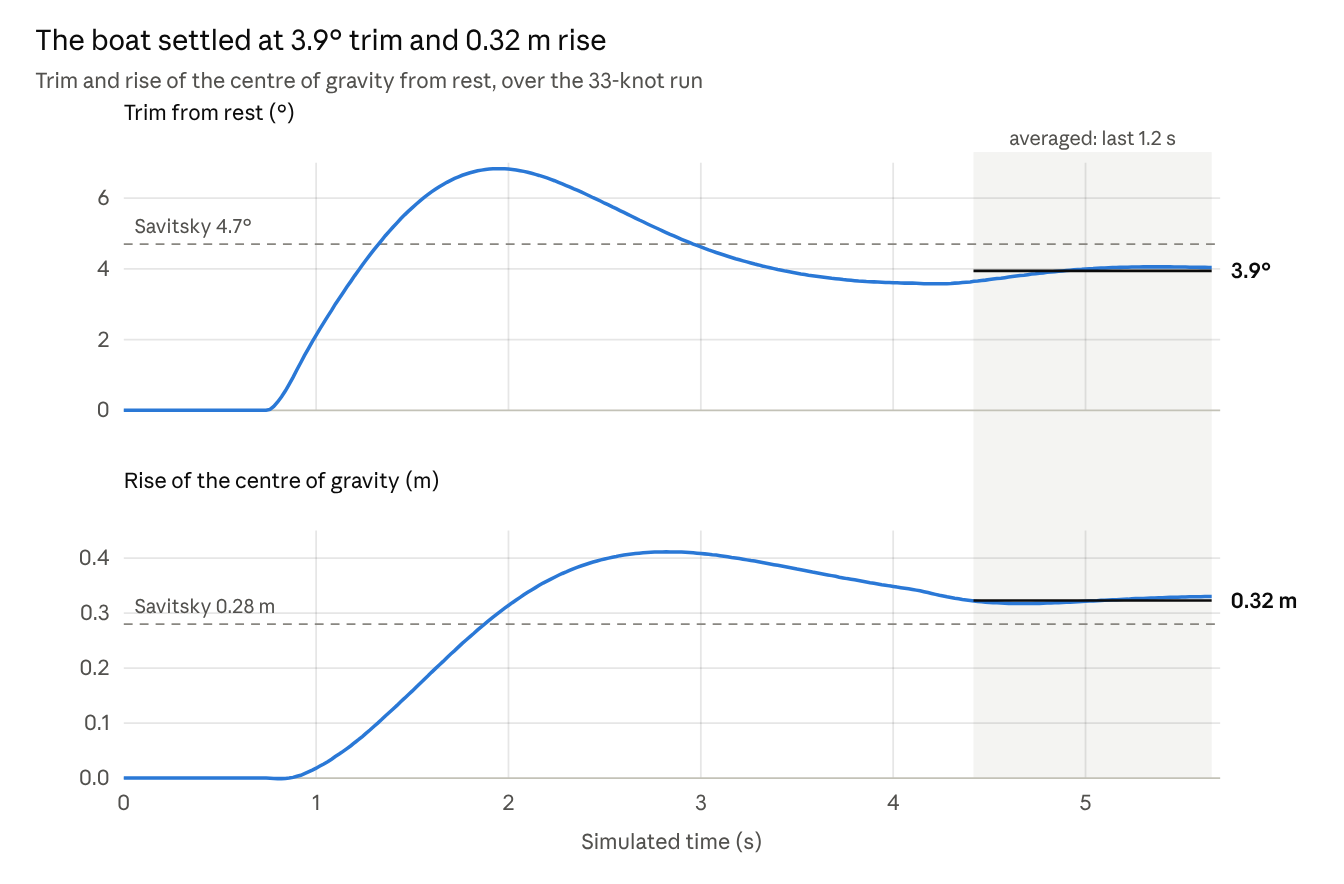
Lift balanced the boat's weight within 1 % (37.3 kN against 36.9 kN), a sign the run had settled into a true running balance.
| Resistance at 33 kn | Value |
|---|---|
| Hull resistance (simulated) | 6.38 kN |
| Hull roughness allowance | 0.80 kN |
| Air resistance (6.5 m² frontal area) | 1.03 kN |
| Total resistance | 8.21 kN |
How it compares
The engine power the simulation calls for, 310–375 hp, brackets the 350 hp outboard that took the boat to 33 knots at full throttle on sea trials. Hull resistance agrees with the Savitsky planing method within 2 %.
| Notilus CFD | Savitsky method | Sea trial | |
|---|---|---|---|
| Trim, from rest | 3.9° | 4.7° | — |
| Rise of the centre of gravity | 0.32 m | 0.28 m | — |
| Hull resistance | 6.4 kN | 6.5 kN | — |
| Engine power at 33 kn | 310–375 hp | — | 350 hp (full throttle) |
The simulation trims the boat 0.8° less than Savitsky, whose 3.4° keel angle is 4.7° from rest on this boat. That is the size of gap published tank tests show: on a standard planing hull form, Savitsky's equations put the trim 0.6–1.2° above the measured value.
From resistance to the engine
Engine sizing starts from the calm-water power, and a 15 % sea margin is added for wind, waves and a fouled hull. With a typical outboard propulsive efficiency of 0.59, the chain lands within 5 % of the engine the boat carries.
| Step | Power |
|---|---|
| Effective power (total resistance × speed) | 139 kW (187 hp) |
| Engine power, calm water (propulsive efficiency 0.59) | 237 kW (318 hp) |
| Engine power with the 15 % sea margin | 273 kW (366 hp) |
| Installed outboard (33 knots at full throttle on sea trials) | 261 kW (350 hp) |
A sea trial is itself a calm-water run, so the strict like-for-like figure is the calm-water line. Across the usual range of outboard propulsive efficiency, 0.60 to 0.50, it runs from 310 to 375 hp — and the trial's 350 hp sits inside that range.
The wave pattern
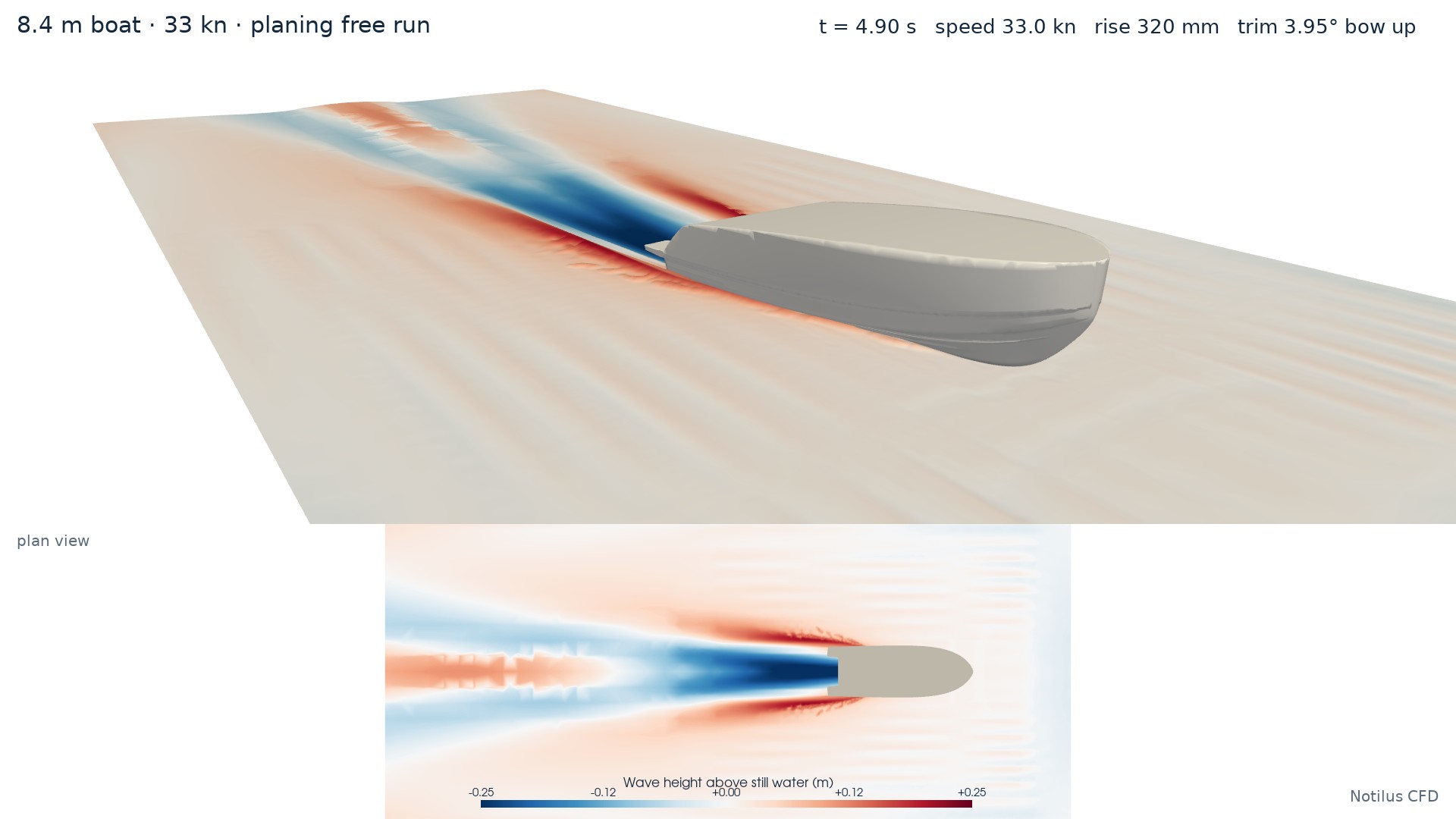
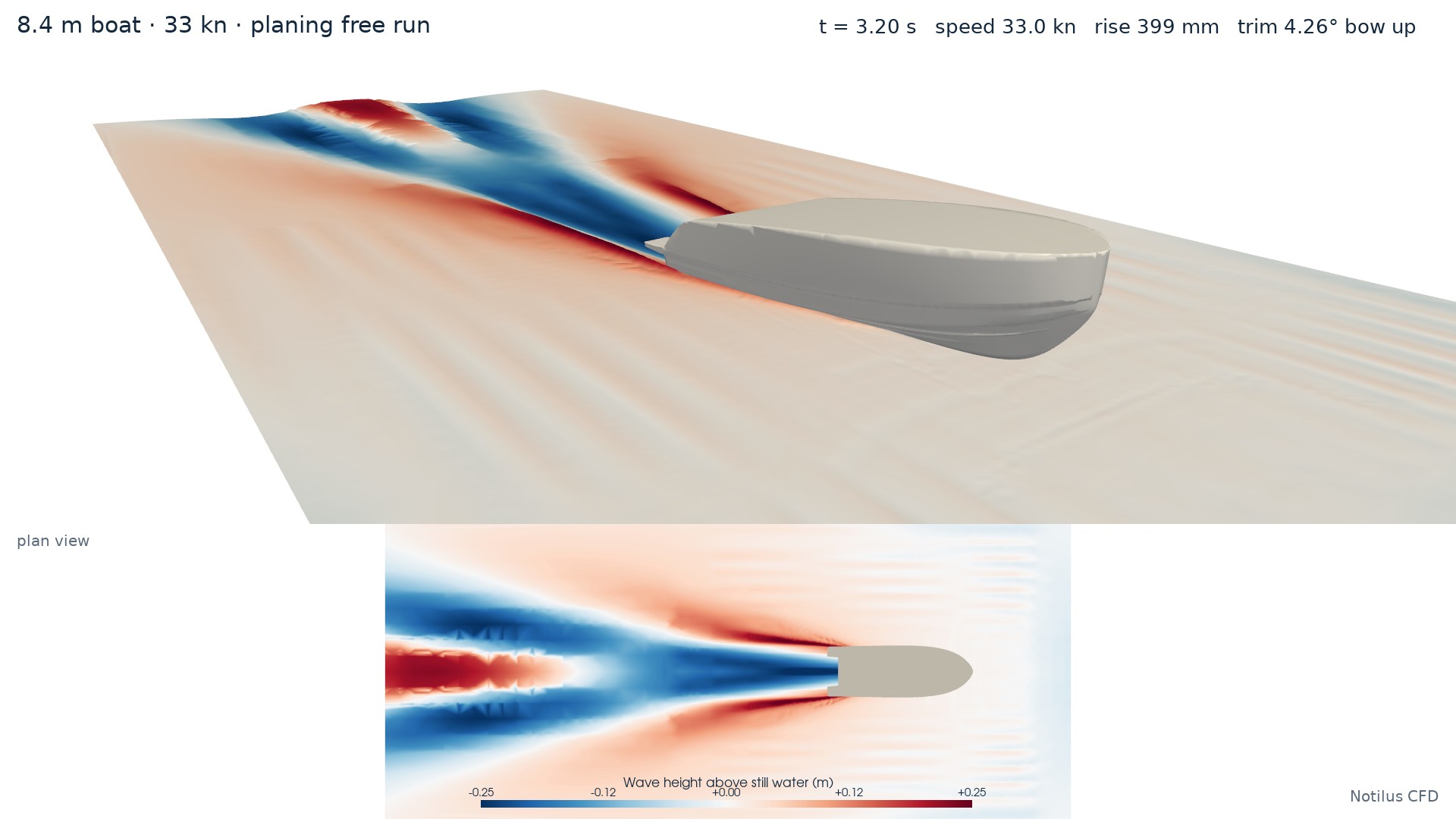
The picture shows the settled run, 4.9 seconds in: the 3D view on top, the plan view below. Colour is the water height above the calm surface, from 0.25 m below (blue) to 0.25 m above (red).
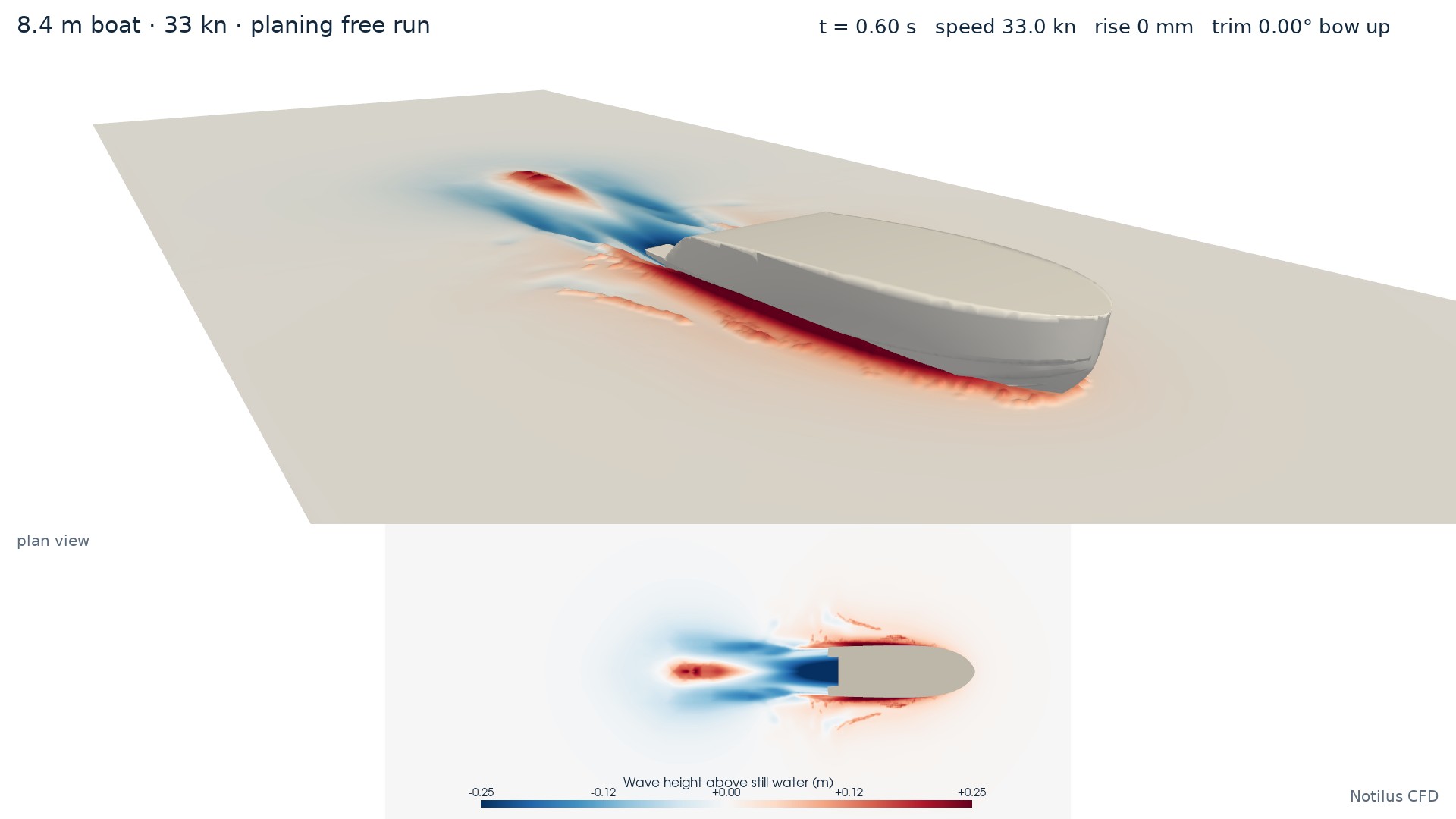
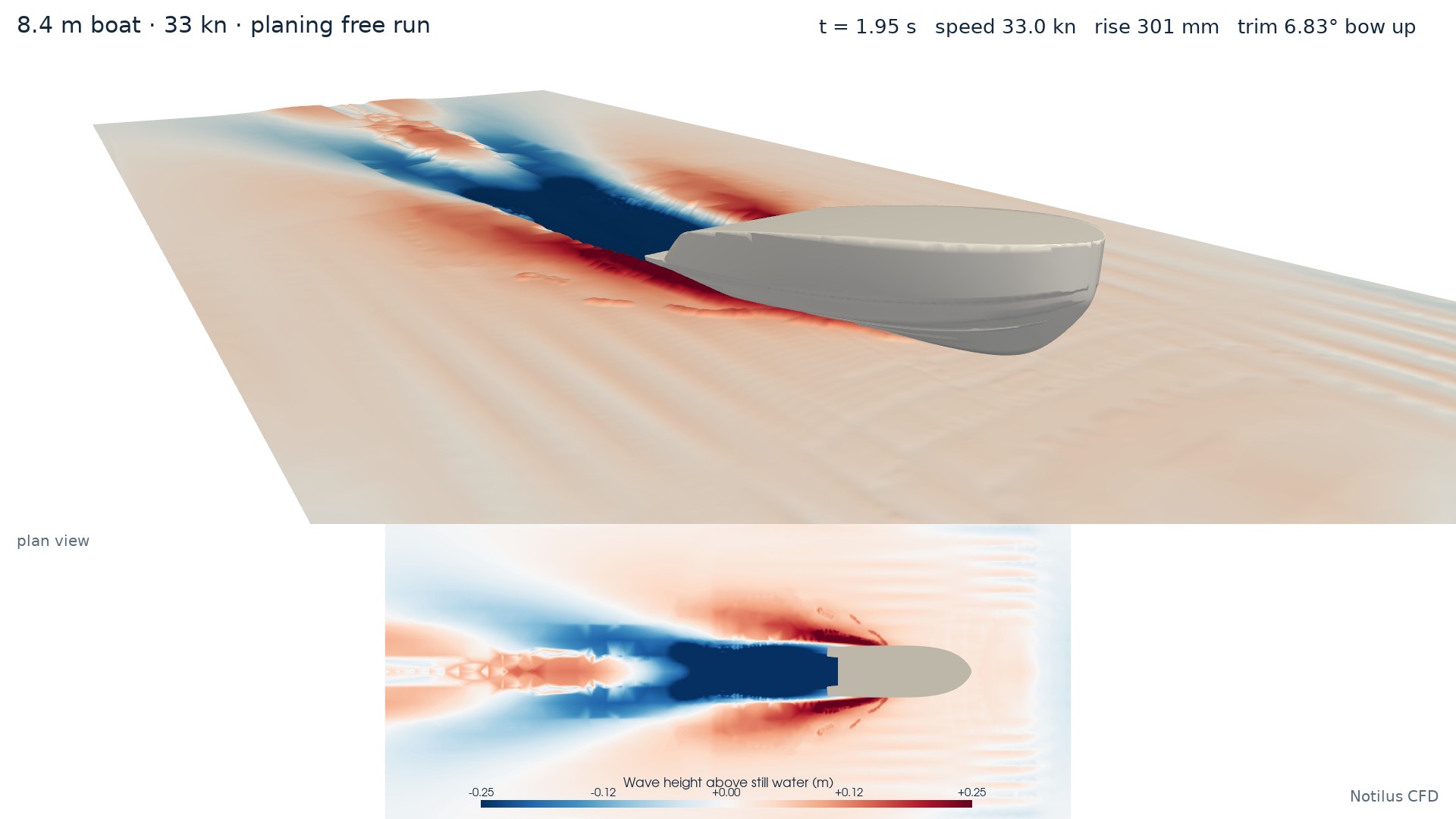
Behind the transom the water drops into a long hollow, and crests run back from the chines on both sides. Where the hollow closes, the water rises into the rooster tail. The 17-second video plays the whole run, from the first moment at speed until the boat settles.
Video — the whole run, 17 s at 2.5× slow motion
The run in pictures
What it means for designers
On a planing hull, lift, trim and resistance hang together: get one wrong and the engine choice is wrong too. A simulation that lets the boat find its own running attitude answers all three at once, on the hull you drew.
Here it matched what the sea trial had shown: the right engine for 33 knots, within the spread of propulsive efficiency. That is the check a designer wants before tooling, not after the first sea trial.
Notilus CFD runs inside Rhino 8. To see what it says about your own hull, write to info@notilussoftware.com or visit notilussoftware.com/product/cfd.
Notilus CFD uses OpenFOAM as its solver backend. OpenFOAM is a registered trademark of OpenCFD Limited, producer and distributor of the OpenFOAM software (openfoam.com). Notilus Software is not affiliated with, endorsed by, or sponsored by OpenCFD Ltd, the OpenFOAM Foundation, or ESI Group. OpenFOAM must be installed separately by the user; Notilus CFD does not distribute or modify OpenFOAM.
CFD results are indicative and are not a substitute for towing-tank testing or naval-architecture certification.