We ran a 40 m motor yacht at its 16.8-knot full-power speed in Notilus CFD, free to sink and trim, and set the result against its sea trial. The calm-water power, with the standard 15 % sea margin added, lands 3 % above the power its engines delivered.
The yacht and the question
The yacht is a 40 m motor yacht with twin diesels driving twin propellers through reduction gearboxes. On its sea trial it floated level and reached 16.8 knots at full power: both engines at their rated speed and full load.
At 16.8 knots a 40 m hull runs near its hump speed, at a Froude number of 0.44. It is past slow displacement running but not yet planing: the waves it makes take most of the power, and the hull sinks and trims as it goes. This is where hand methods are least sure of themselves.
We wanted to know what a full simulation inside Rhino would say about the engine power, for a yacht whose answer we already had.
What we simulated
Notilus CFD ran the hull as drawn in Rhino, at full scale, in calm water at 16.8 knots and at the same displacement as on the sea trial. The hull was free to sink and to trim, so it found its own running attitude. The run stopped by itself once sinkage, trim and resistance had stopped changing.
The figures below are averages over the last 11 seconds of the run. Sinkage and trim are measured from the yacht's attitude at rest; sinkage is given as a share of the draft at rest.
The simulation gives the resistance of the bare hull in the water. On top of it come a standard allowance for hull roughness, 9 % for the rudders, shafts, brackets and fins, and the air resistance of the yacht's superstructure. The engine power then follows from the propellers' own design efficiency.
Results
The yacht settled at 0.31° of bow-up trim and sank by 9 % of its draft. The simulated hull resistance makes up 87 % of the total; hull roughness, appendages and air add the rest.
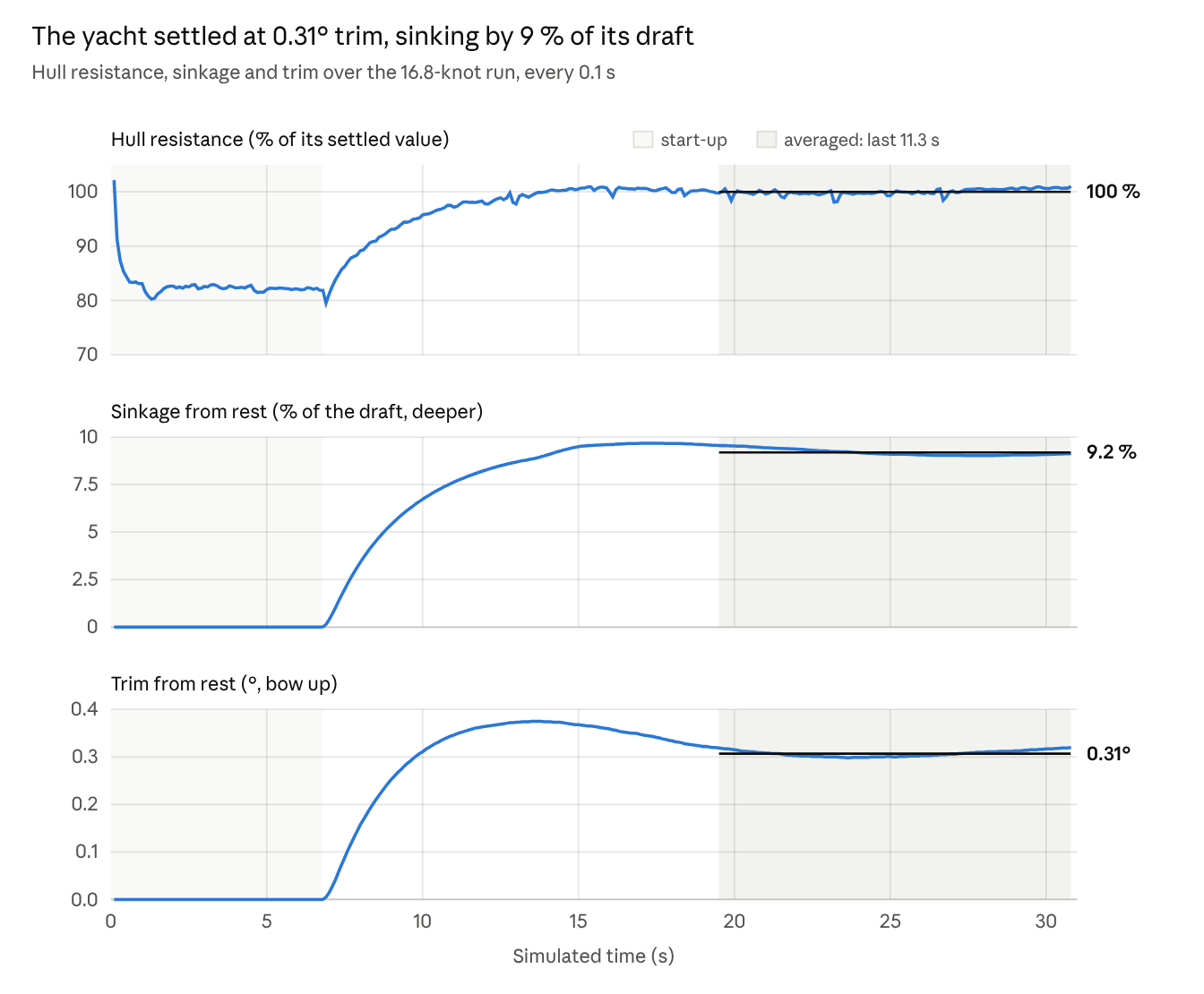
Lift balanced the yacht's weight to within 0.1 %, a sign the run had settled into a true running balance.
| Resistance at 16.8 kn | Share of the total |
|---|---|
| Hull resistance (simulated) | 87 % |
| Hull roughness allowance | 3 % |
| Appendages (9 % of the hull resistance) | 8 % |
| Air resistance of the superstructure | 2 % |
| Total resistance | 100 % |
How it compares with the sea trial
The sea trial gives one firm number to check against: at 16.8 knots both engines were at full power. Every power figure below is a share of that full power. The trial day was not calm: a Beaufort 5 wind blew from the beam, and the wave height was not recorded.
| Notilus CFD | Sea trial | |
|---|---|---|
| Speed | 16.8 kn | 16.8 kn, at full power |
| Displacement | the same as on the trial | trial displacement |
| Trim at rest | level | level |
| Wind | still air | Beaufort 5 from the beam |
| Waves | calm water | not recorded |
| Running sinkage and trim | 9 % of the draft deeper, 0.31° bow up | not measured |
| Engine power at 16.8 kn | 89 % of the trial power in calm water, 103 % with the 15 % sea margin | 100 % (both engines at full power) |
From resistance to the engine
The total resistance becomes engine power in three steps. Multiplied by the speed, it gives the effective power. The propellers' design efficiency, 60.6 %, and a thrust deduction of 8 % give a propulsive efficiency of 55.8 % at this speed, and the shafts and gearboxes lose another 4.5 %: that is the power the engines need in calm water. A 15 % sea margin is then added for wind, waves and a hull that is no longer new.
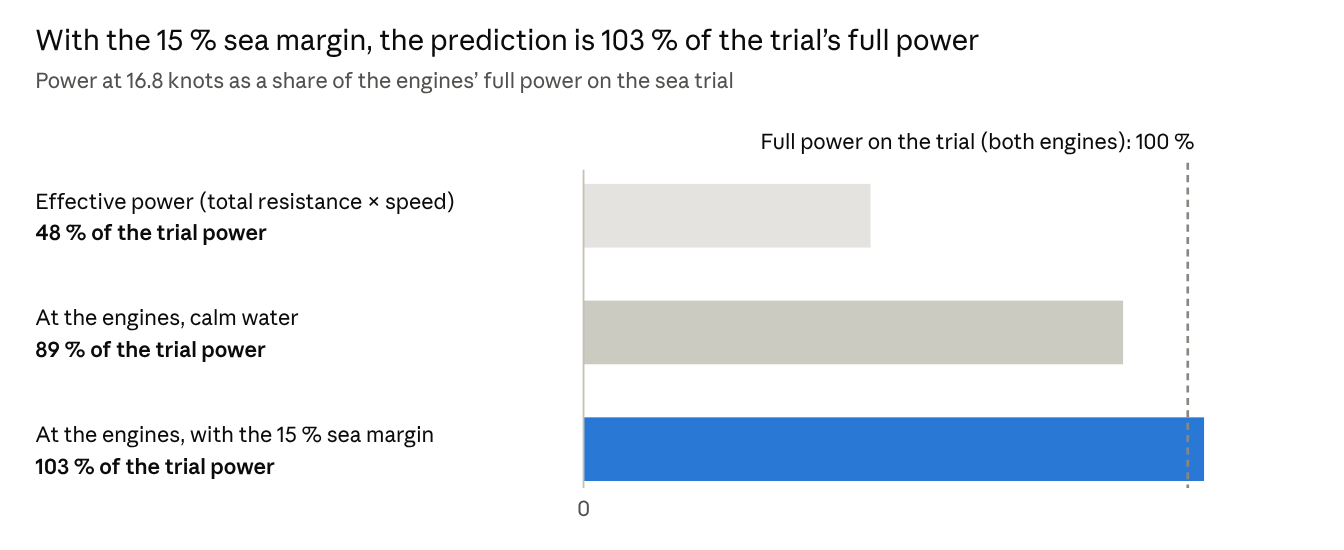
The strict like-for-like figure is the calm-water power. The trial ran in a Beaufort 5 wind, the kind of day the sea margin is there for. A trial in wind and waves cannot separate the hull's own resistance from the weather's share, so this comparison checks the engine sizing, not the resistance to the last per cent.
The wave pattern
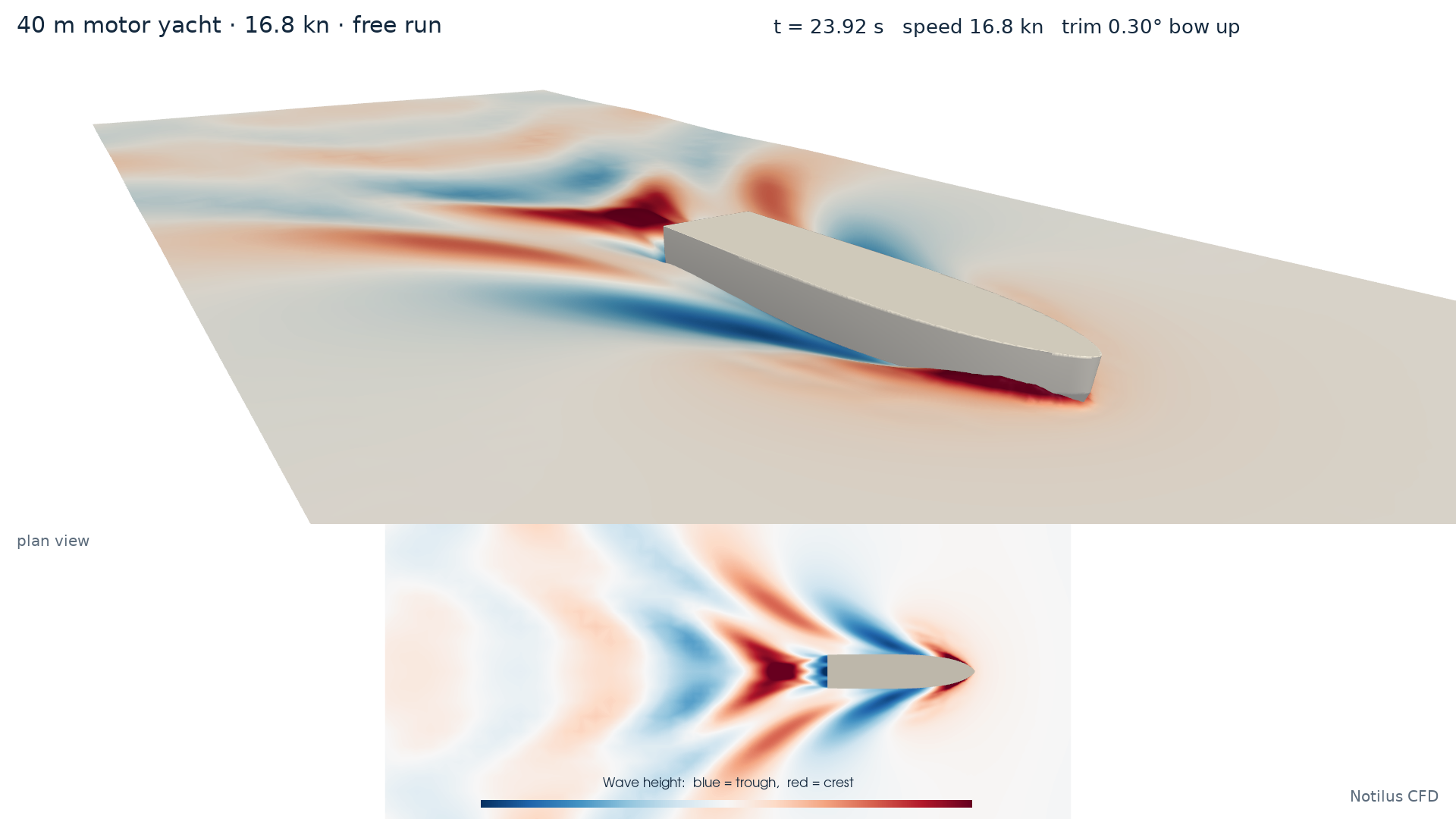
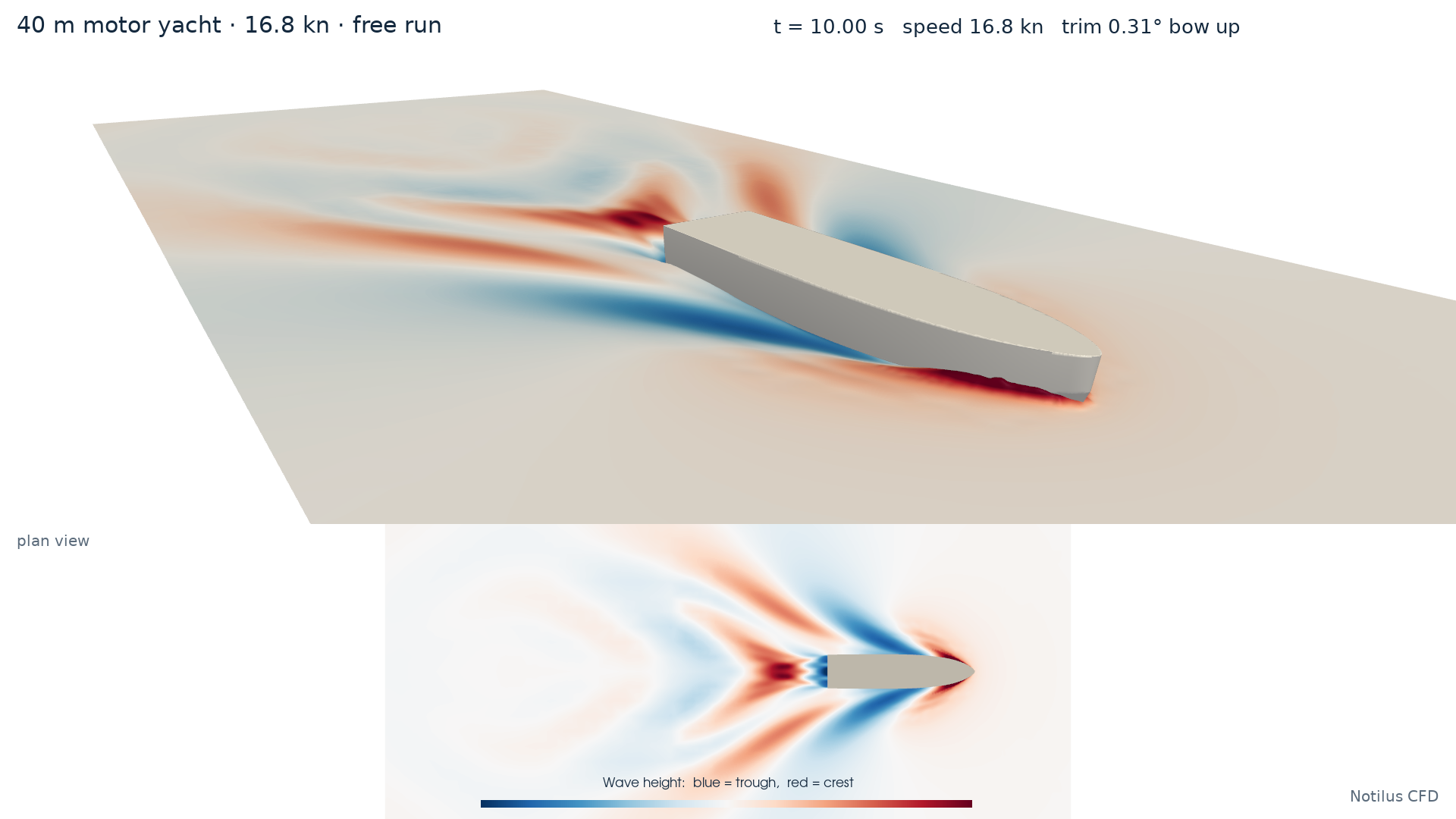
The picture shows the settled run, 23.9 seconds in: the 3D view on top, the plan view below. Colour is the water height: blue below the calm surface (troughs), red above it (crests).
At 16.8 knots the yacht makes a transverse wave about 48 m long, longer than the hull itself. The bow lifts the water into a crest, a long trough runs aft along both sides, and the next crest rises just behind the transom. With that trough under its after body, the yacht sinks and trims slightly bow up. On both sides the diverging waves spread out in the familiar Kelvin pattern.
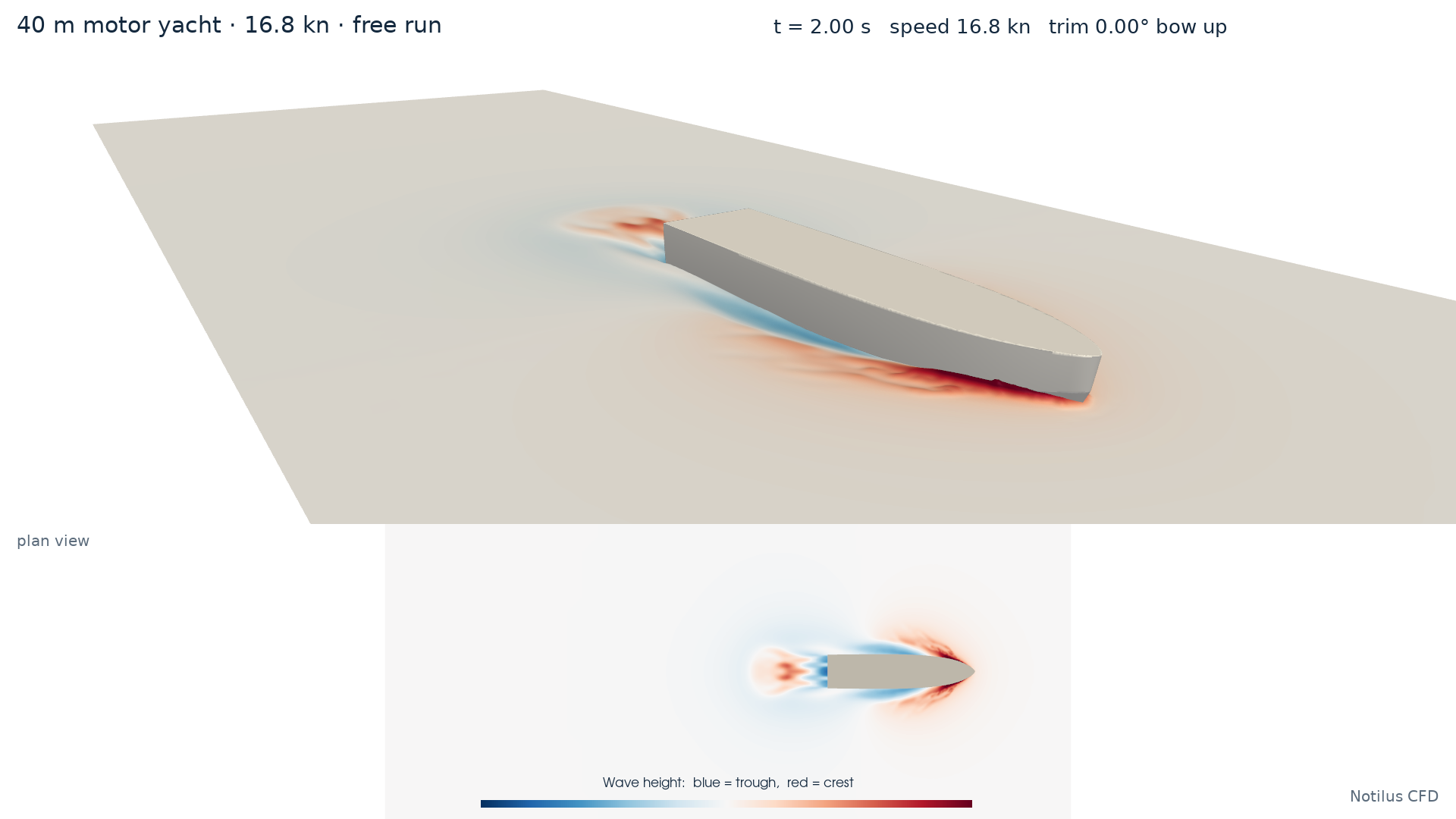
Video — the whole run, 34 s in real time
The run in pictures
What it means
At 16.8 knots three quarters of this hull's resistance is pressure, most of it from the waves the yacht makes, and those waves depend on how it sinks and trims. A simulation that lets the hull find its own running attitude answers both at once, on the hull as drawn.
Here the calm-water prediction, with the standard sea margin, came to 103 % of the power the yacht's engines delivered on its sea trial. That is the answer you want before the engines are chosen, not after the first trial.
Notilus CFD runs inside Rhino 8. To see what it says about your own hull, write to info@notilussoftware.com or visit notilussoftware.com/product/cfd.
Notilus CFD uses OpenFOAM as its solver backend. OpenFOAM is a registered trademark of OpenCFD Limited, producer and distributor of the OpenFOAM software (openfoam.com). Notilus Software is not affiliated with, endorsed by, or sponsored by OpenCFD Ltd, the OpenFOAM Foundation, or ESI Group. OpenFOAM must be installed separately by the user; Notilus CFD does not distribute or modify OpenFOAM.
CFD results are indicative and are not a substitute for towing-tank testing or naval-architecture certification.